
20 Facts About Swans
The Fascist Swan, the Queer Swan, and the Wetland Between Them

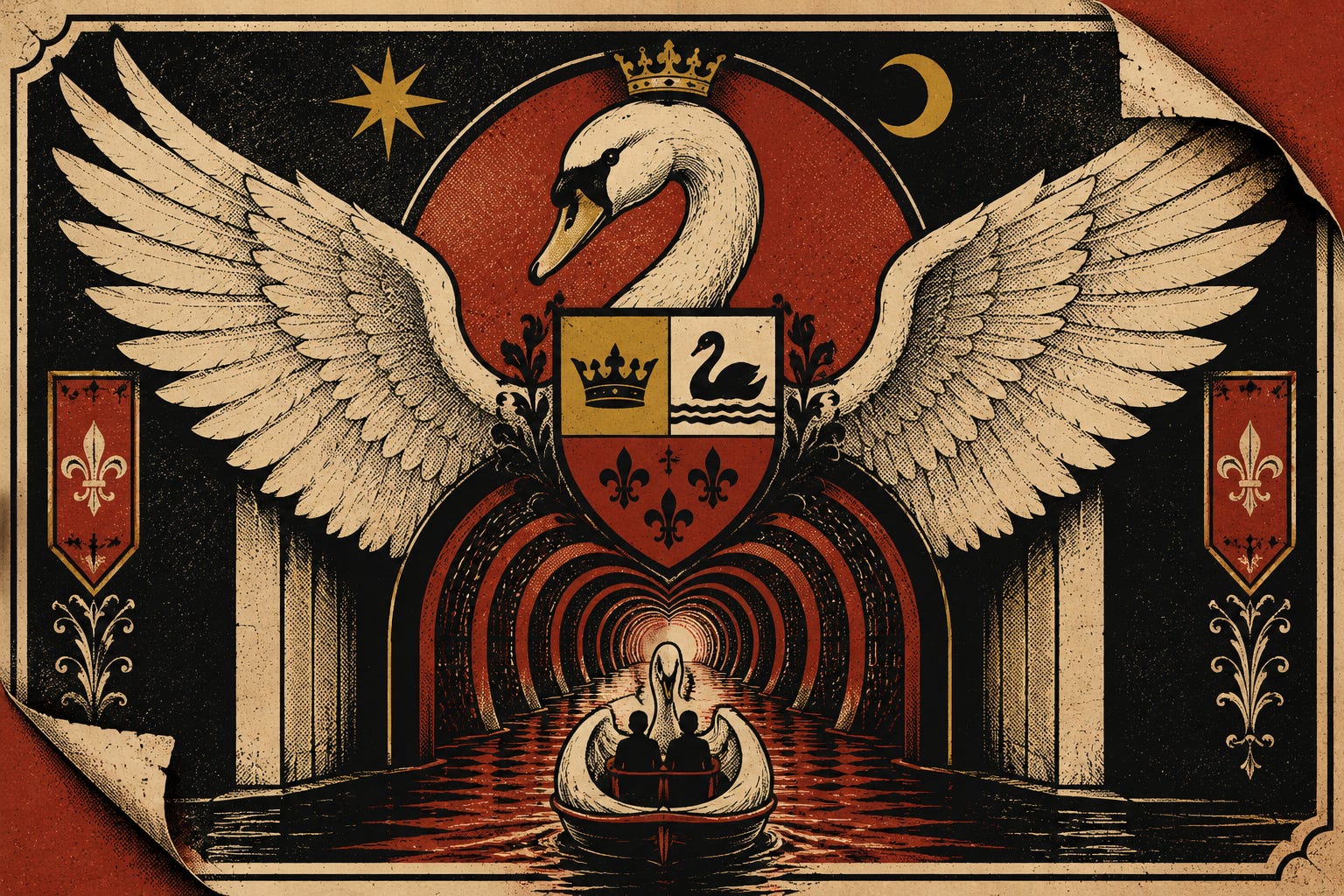
Swans are what happens when evolution accidentally designs a luxury liner with anger issues. They move through culture like symbols that escaped containment: purity, monarchy, transformation, fascism, ballet, queer longing, divine rape, impossible beauty, maternal violence, bad tempers in public parks. They look ornamental right up until they start breaking bones.
And unlike many symbolic animals, swans have spent centuries collaborating with the propaganda. 🦢
THE 20 FACTS
The phrase “swan song” comes from an ancient belief that swans sing beautifully just before death. Aristotle doubted it. Pliny repeated it anyway. Humans heard one dramatic noise from a dying bird and immediately invented an entire philosophy of final artistic statements.
In medieval England, mute swans were legally owned by the Crown. Not metaphorically. Literally. To eat one without permission was aristocratic poaching. Swans functioned partly as floating royal property. Tiny feathery yachts of monarchy.
The annual “Swan Upping” ceremony on the River Thames still exists. Officials in scarlet uniforms travel by boat counting royal swans like they’re conducting a census in a fantasy novel.
Swans are extremely aggressive because they are unusually invested parents. Most waterfowl can flee danger by taking off quickly. Swans are enormous and slow to launch, so evolution pushed them toward territorial intimidation instead. Their strategy is less “escape” and more “become a Victorian warship.”
A swan’s wings can span over seven feet. When threatened, they arch them into a display called “busking,” turning themselves into living heraldic symbols. They are basically self-inflating coats of arms.
The ballet Swan Lake helped solidify the swan as an icon of tragic femininity, but the ballet’s emotional engine is transformation anxiety. Odette is trapped between forms, visible and inaccessible at the same time. Half woman. Half state-sponsored water curse.
In many folktales cataloged in the Motif-Index of Folk-Literature, swan maidens are women whose feather cloaks are stolen so they cannot return home. The “romance” structure often hinges on confinement disguised as marriage.
Zeus seduced or assaulted Leda while disguised as a swan in the Greek myth of Leda and the Swan. Western art spent centuries painting this scene as elegant eroticism while quietly smuggling in divine coercion. Renaissance galleries are full of extremely expensive bird crimes.
The “ugly duckling” is not actually a duckling. In The Ugly Duckling, the protagonist was a swan the entire time. The story is less “be yourself” than “you are suffering because you were born into the wrong species narrative.” Queer writer Hans Christian Anderson knew what he was doing.
In Northern European folklore, swans are frequently liminal creatures connected to winter lakes, ghost women, shape-shifting brides, and thresholds between worlds. They behave like elegant border patrol agents for the uncanny.
Biologically, black swans transformed philosophy. Europeans assumed all swans were white because they had only encountered white species. Then Dutch explorers found black swans in Australia in the 17th century, and suddenly an entire epistemological certainty collapsed. One bird accidentally humiliated Western universalism.
Philosopher Karl Popper later used black swans to explain falsifiability: no number of white swans proves all swans are white, but one black swan destroys the theory instantly. Nassim Taleb then turned the phrase “Black Swan” into shorthand for catastrophic unpredictable events. A water bird became risk-management infrastructure.
Swans are weirdly loud. Popular imagination remembers them as silent gliders, but trumpeter swans sound like haunted brass instruments and tundra swans can resemble distant ghost sirens over wetlands.
The actress Elsa Lanchester reportedly studied swans to develop the iconic hiss of the Bride in Bride of Frankenstein. Which means one of horror cinema’s defining monster sounds is essentially “aggressive pond aristocrat.”
Nazi aesthetics occasionally borrowed swan imagery because swans already carried associations with whiteness, purity, Wagnerian romanticism, and aristocratic myth. Fascism loves preloaded symbolism. It prefers symbols that arrive already carrying emotional furniture.
At the same time, swans became queer icons in ballet culture, camp melodrama, and transformation narratives. The same animal got recruited simultaneously by authoritarian purity myths and by stories about unstable identity and metamorphosis. Few creatures ricochet so violently between ideological uses.
In ecology, swans reshape entire wetlands. Their feeding uproots aquatic vegetation, changes sediment structure, and alters habitats for fish and insects. They are not decorations placed onto ecosystems. They are ecosystem editors.
Some swans mate for life, but not always. The Victorian fantasy of eternal swan monogamy was partly projection. Ornithologists have documented divorce, same-sex pairings, adoption behavior, and occasional spectacular interpersonal drama. Even swans contain tabloids.
The phrase “white swan” versus “black swan” accidentally reproduces an old symbolic hierarchy where whiteness means normativity and blackness means anomaly or disruption. The birds themselves did not request this philosophical assignment. They were just out there being birds.
A swan on dark water often feels less like an animal than a rendering problem. Too symmetrical. Too deliberate. Too theatrical in motion. Like nature briefly wandered into set design and forgot to leave.
SO WHAT DOES THIS MEAN?
Here’s the through-line these facts reveal:
Swans are machines for projection. Humans keep loading them with systems larger than the birds themselves: monarchy, beauty, race, femininity, apocalypse, elegance, nationalism, transformation, romance. The actual animal underneath all this symbolic scaffolding is territorial, ecological, noisy, muscular, and occasionally vindictive.
Which is maybe why they endure culturally.
Swans expose how often “purity” is manufactured through selective framing. Pull back slightly and the graceful icon becomes a hissing parent protecting its territory with startling violence. Pull back further and the symbol fractures into competing stories: queer metamorphosis, aristocratic ownership, ecological disruption, divine violation, epistemological collapse.
The swan keeps revealing that beauty and aggression are not opposites. They are frequently roommates.
UNEXPECTED CONNECTIONS
This topic rhymes with:
The selkie myths of Scotland and Ireland, where removing an animal skin traps a supernatural being in domestic life
Queer adolescence as “wrong species” recognition rather than simple self-discovery
Black Swan as body horror about perfection becoming predation
Public parks, where the decorative fantasy of nature collides with the reality that wildlife has opinions
Outlaw Magick’s interest in creatures transformed by systems that mistake beauty for obedience
POTENTIAL SUBSTACK ESSAYS TO SPIN OFF
“The Fascist Swan and the Queer Swan”
“Why the Ugly Duckling Is Secretly About Species Dysphoria”
“Swan Lake and the Horror of Conditional Femininity”
“The Royal Bird Census: Monarchy as Fantasy Franchise”
“Elsa Lanchester Learned Horror Acting from Waterfowl”
“Black Swans and the End of Certainty”
QUESTIONS FOR FURTHER STUDY
What I want to know next:
Why do humans repeatedly eroticize birds associated with danger?
How did ballet permanently alter the emotional symbolism of swans in the West?
Are there non-European traditions where swans symbolize something completely different?
What other animals became overloaded with contradictory ideological meanings?
THE OUTRO BUTTON
In short, swans may be one of humanity’s favorite examples of symbolic overbooking. We looked at a large wet bird and somehow extracted monarchy, ballet, fascism, lesbian yearning, philosophy of science, and several hundred years of unresolved transformation anxiety.
The swan, meanwhile, remains busy terrorizing paddleboats.